


Showing posts with label english teachers. Show all posts
Showing posts with label english teachers. Show all posts
Monday, April 08, 2013
1 comment | Monday, April 08, 2013
Have you ever wondered why a word is not pronounced as it is spelt? I am
sure, you would have felt awkward more than once over this issue.
Sometimes they arise due to silent letters whereas at other times it is
due to stressed pronunciation. These are the two major categories of
confusion when it comes to English pronunciation. In this article we
would explore the possibilities and nuances of silent words and their
pronunciation.
Let us begin by understanding what a silent letter is in alphabetic writing system. A silent letter is a letter that appears in a particular word, but it has no effect on the pronunciation of the word. In other words silent letters effectively exist in written world whereas they do not make their presence felt in verbal world. This fine line of difference not only causes problems for non-native English speakers but also for the native English speakers. It becomes difficult to guess the spelling of the word by hearing its pronunciation.
Causes for silent letters:
Over the period of time the sound has dropped out of the spelling of the word. This essentially means they would still be retaining the same spelling but a different pronunciation. The word knot would fit this historical change quite aptly. Apart from this historical change, the major cause of these silent letters is English language borrowings from other languages. Words like Khaki made their presence felt from non-native English origins. Since accent and pronunciation differ, letters may be silent for some speakers but not for the others. In some accents, is silent in such words as hard, feathered; in h-dropping accents, is silent. A speaker may pronounce in “often” or “tsunami” or neither or both. All of these make silent letters more than important for English communication. Just to quote an example, how else would you differentiate a whole from a hole or a plumb from a plum without the help of silent letters?
Examples of Silent Letters
Unfortunately there are no hard and fast rules to learn silent letters. Their usage is learnt by prior exposure and experience. Here is a list of silent letters for your learning purpose.

Check out this video for more details
No comments | Monday, April 08, 2013
Building a Teacher Support System
Using Collaborative Web Tools.
Each day, somewhere around the world, a teacher will walk
into a classroom and plant a seed in a student. Each interaction a
teacher has with a student is an opportunity to plant positive learning
seeds. It is a moment to encourage students to explore their
curiosities, pursue their passions, and get excited about the learning
process. For many teachers this is a stressful and challenging process.
Several of them feel like chained elephants bounded by their
curriculums, national standards, standardized tests results, and
education policy. This reality results in various missed teachable
moments and missed opportunities for teachers to instill a desire for
learning. This reality means teachers are drilling, teaching to tests,
and lecturing. They are too frightened to take risks and capitalize on
teachable moments.
Support through a school social network
Schools have the ability to support
teacher innovation, risk-taking, and collaboration by setting up a
support and mentoring system in their schools. Various free web tools
and social networks offer teachers the ability to connect with each
other and collaborate. In the We Connect Video, various teachers and students delineate the reasons to collaborate and learn through social networks.
Which tools are the best?
Administrators need to decide on which
tools best meet their needs. Various schools have instilled a support
network using a combination of tools, such as:
- having a hashtag on Twitter to place announcements or host a chat
- setting up a Facebook group for their teachers
- setting up a group on Edmodo, Wiggio, or a Ning
- creating a collaborative wiki or blog
- setting up virtual meetings on Google Hang Outs on Air
- setting up a Moodle for teachers and students
These platforms help teachers mentor each other online,
share lesson ideas, host virtual meetings online, collaborate on lesson
ideas, create a database of various lesson resources, post questions,
answer questions, share frustrations or barriers they face in classes,
share solutions to various problems and so much more. The online
collaboration tool is not meant to replace frequent face- to- face
collaboration. It is meant to spur and support the collaboration that
takes place in these meetings year-round. The benefits include that
these platforms are easily accessible anytime and anywhere there is an
Internet connection.
When school administrators decide to create an online collaborative platform, they should consider the following:
- What are the platforms’ communication options?
- What archiving options does the platform have?
- What are the storage options?
- How much time is the staff willing to dedicate to participating on the platform?
- How user-friendly is the platform?
- Does the staff have access to the platform in and out of school?
- Does the platform support asynchronous and synchronous learning?
How do we get teachers to contribute their knowledge?
Administrators then need to determine how to best motivate
teachers to use the platform to support each other and collaborate.
They also need to consider how to motivate teachers to participate by
sharing materials and knowledge. Many schools miss this crucial step and
feel the platform has failed. Creating a collaborative environment and
getting teachers to participate will take time and support. First, the
teachers have to be trained on how to use the platform. Various of these
collaborative tools have video tutorials and step by step manuals on
how to use the platform. These should be some of the first items listed
on the platform and shared at a hands-on workshop.
School administrators can also jumpstart the process by
pulling aside teachers who exhibit great leadership skills in various
subject areas and departments and give them specific roles on the
platform. School administrators should discuss with these teacher
leaders why the platform is in place and what they hope to accomplish
with the online collaboration. They should seek their ideas in getting
teachers to participate and collaborate. Some roles they can ask for
help in immediately is sharing materials online. They should also ask
the teacher leaders to support questions asked in the group or show
support through likes or comments when teachers do post items in the
group.
School administrators can also show support of their
platforms by mentioning resources that were shared at meetings,
functions or in the school paper or intercom announcements. More
teachers will be encouraged to share their resources and more of the
resources will be used. The idea is to get the online support to
translate into instructional practice. This means that the sharing
cannot just be online. School administrators need to take that extra
step to highlighting what takes place online so that teachers see that
the online platform is fully supported by the school leadership.
How online collaboration translates into school culture
Online collaboration improves a school’s culture and
environment because when teachers improve their practice, students
benefit. Online collaboration, when supported and implemented
effectively, allows for continuous learning and collaboration. Teachers
who are supported and learn continuously are better teachers. They
reflect on their instructional practice and make improvements. They get
excited by an idea and try it. They tend to have a proactive approach to
the problems they face in their classrooms versus shutting down and
hoping to get through the year. They tend to communicate better with
parents and students. They also tend to have a better attitude and mood,
which enhances student learning. Too many schools have policies that
currently block social networks instead of taking advantage of their
benefits. Our students are already learning on social networks. It is
time we began to familiarize ourselves with the process so that we can
raise digital learners who use these tools to collaborate and problem
solve.
No comments | Monday, April 08, 2013
What is Project-based Learning?
PBL is an approach to instruction that shifts from traditional teaching practices
characterized by short, isolated, and teacher-centered lessons. Instead, it
emphasizes learning that can be derived from long-term activities, which are
interdisciplinary, student-centered, and integrated with real world issues and
practices (Solomon, 2003; Staff, 2001; Willie, 2001). Many of the skills
learned through PBL are those desired by today's employers, including the
ability to work well with others and handle interpersonal conflicts, make
thoughtful decisions, practice initiative, and solve complex problems
(Kloppenborg & Baucus, 2004).
Students are provided an interdisciplinary approach to learning
and in the process made to develop several skills successively or at the same
time as they work on a challenging project (Solomon, 2003). 3
1. Definition
from the Autodesk Foundation :
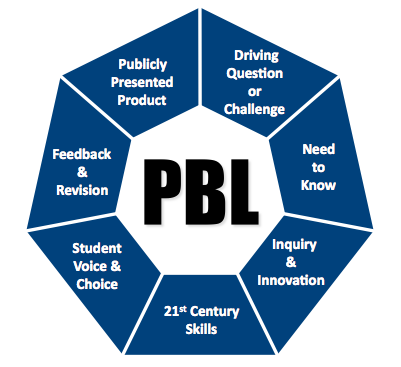
• Engage and build on student interests and
passions
• Provide a meaningful and authentic context
for learning
• Immerse students in complex, real-world
problems/ investigations without a predetermined solution
• Allow students to take the lead, making
critical choices and decisions
• connect students with community resources and
experts
• Require students to develop and demonstrate
essential skills and knowledge
• Draw on multiple disciplines to solve
problems and deepen understanding
• Build in opportunities for reflection and
self-assessment
• Result in useful products that demonstrate
what students have learned
• Culminate in exhibitions or presentations to
an authentic audience
2.
The
Importance of Conceptual Model for PBL
Those who advocate for PBL do not necessarily assert that it is
exclusively the most effective educational approach there is but Staff (2001)
observes that it is a way to make students engaged in school work, cut
absenteeism, boost cooperative learning skills, and improve test scores. The
students were able to develop self-motivation, initiative, and teamwork. In the
study of Brunetti, Petrell, and Sawada (2003), higher achievement awareness was
evident among students in universities instituting PBL compared to those
heavily entrenched in the practice of traditional teaching. The ability to
exhibit creativity and analytical skills in solving problems were displayed by
the students. The research of Kloppenborg and Baucus (2004) reports on the
learning outcomes of students as manifested in their successful experiences
gained in planning, managing, and accomplishing projects. Successful
experiences include the ability to resolve conflicts through creative
problem-solving approaches and the accomplishment of a project that made them
more aware of real life problems and issues. Learning then was fruitful for the
students involved and not just mere assimilation of content-based knowledge.
3. Aim & Objectives of Project Work (PW)
PW is an integrated learning experience that encourages students to break away from
the compartmentalisation of the different disciplines. It aims to provide students
with opportunities to explore the inter-relationships and inter-connectedness
of subject-specific knowledge. The
objectives of PW are to allow students to:
§ Apply creative and critical
thinking skills
§
Improve
communication skills (both oral and written)
§
Foster
collaborative learning skills
§ Develop self-directed inquiry
and life-long learning skills
PW has been implemented in schools since 2000. At secondary level, it is
recommended that PW be implemented at Primary 3, Primary 4 and/or Primary 5,
and at Secondary 1, Secondary 2 and/or Secondary 3. By 2002, all primary and
secondary schools are expected to implement PW at at least one level.
At the pre-university level, PW is implemented at JC1 and CI2. JC1 and CI2
students in 2003 will sit for the PW national examination, and the result
obtained will count towards entry into local universities from 2005 onwards.
4. Features of Project-Based Learning
There are several features that
facilitate use of project-based instruction within a classroom. It is important
to provide students with a specific focus. What you expect of them from the
project. It is important that the project has a real world connection. This can
be achieved through making several connections to real life experiences.
The project needs to allow students to not only make real life connections
but also implement decision making skills, learning and applying new concepts
and using their knowledge through a variety of education contexts.
Working together with others. Collaborating with other students is a key
element of Project based learning. As well as teachers and the broader
community.
Implementing research in a variety of environmental contexts is imperative
through the application of several technologies including, computer programs, audio
visual equipment and real life research to ensure that the full experience of
the project is gained.
Take a closer look at the wikipedia search result for Project-Based Learning here: wikipedia
Take a closer look at the wikipedia search result for Project-Based Learning here: wikipedia
5. Roles
PBL relies on learning groups. Student groups determine their
projects, in so doing, they engage student voice by encouraging students to take full responsibility
for their learning. This is what makes PBL constructivist. Students work together to accomplish specific goals.
When students use technology as a tool to communicate with others,
they take on an active role vs. a passive role of transmitting the information
by a teacher, a book, or broadcast. The student is constantly making choices on
how to obtain, display, or manipulate information. Technology makes it possible
for students to think actively about the choices they make and execute. Every
student has the opportunity to get involved either individually or as a group.
Instructor role in Project Based
Learning is that of a facilitator. They do not relinquish control of the
classroom or student learning but rather develop an atmosphere of shared
responsibility. The Instructor must structure the proposed question/issue so as
to direct the student's learning toward content-based materials. The instructor
must regulate student success with intermittent, transitional goals to ensure
student projects remain focused and students have a deep understanding of the
concepts being investigated. It is important for teachers not to provide the students
any answers because it defeats the learning and investigating process. Once the
project is finished, the instructor provides the students with feedback that
will help them strengthen their skills for their next project
Student role is to ask questions, build knowledge, and
determine a real-world solution to the issue/question presented. Students must
collaborate expanding their active listening skills and requiring them to
engage in intelligent focused communication. Therefore, allowing them to think rationally
on how to solve problems. PBL forces students to take ownership of their
success.
6. Purpose
Project-based learning (PBL):
best defined as instruction relating questions and
technology relative to the students' everyday lives to classroom projects.
Students form their own investigation of their own group which allows students
to develop valuable research skills. The students engage in design, problem
solving, decision making, and investigative activities. It allows students to
work in groups or by themselves and allows them to come up with ideas and
realistic solutions or presentations. Students take a problem and apply it to a
real life situation with these projects.
Project-based Learning (PBL) provides complex tasks
based on challenging questions or problems that involve the students' problem
solving, decision making, investigative skills, and reflection that include
teacher facilitation, but not direction. Project Based Learning is focused on
questions that drive students to encounter the central concepts and principles
of a subject hands-on.
With Project-based learning students learn from these
experiences and take them into account and apply them to their lives in the
real world.
7. Structure
Project-based learning(PBL): is an approach for
classroom activity that emphasizes learning activities that are long-term,
interdisciplinary and student-centered. This approach is generally less structured
tha teacher-led classroom activities; in a project-based class, students often
must organize their own work and manage their own time. Within the project
based learning framework students collaborate, working together to make sense
of what is going on. Project-based instruction differs from inquiry-based
activity by its emphasis on collaborative learning. Additionally, project-based
instruction differs from traditional inquiry by its emphasis on students' own
artifact construction to represent what is being learned.
8. Elements
The core idea of project-based learning is that
real-world problems capture students' interest and provoke serious thinking as
the students acquire and apply new knowledge in a problem-solving context. The
teacher plays the role of facilitator, working with students to frame
worthwhile questions, structuring meaningful tasks, coaching both knowledge
development and social skills, and carefully assessing what students have
learned from the experience. Advocates assert that project-based learning helps
prepare students for the thinking and collaboration skills required in the
workplace.
9. Teachers’ perception of autonomous learning:
Prior to working on PBL, the two senior
teacher researchers A & B, expressed doubt if students will opt to work on
a project, which was not directly related to examinations and grades. “Our
students in government colleges are comparatively slow, lazy, lack
concentration to work and are not often ready to accept new ideas.” Researcher
C opined that “there is always unlimited capacity in every learner to learn,
only the learning environment is limited.” However, Researcher D gave a more
positive response, saying “my learners are enthusiastic about learning English.
I believe that if this enthusiasm is channeled and guided properly, they are
surely capable of learning on their own.” Researcher A and E accepted that they
had “never heard of the term ‘learner autonomy’ ” Also, the interviews brought
out the fact that none of them had ever considered learner autonomy as a
teaching strategy. This may suggest that teachers are unaware of this as a rich
resource for effective learning.
10. Learners’ views:
10. Learners’ views:
1. Lack of time
Although most of the learners enjoyed the PBL
activity, but a few complained of lack of time. “ It gets stressful sometimes
when we get many assignments of other subjects and we have to do this. One
cannot give much time to this and enjoy it [E22]
2. Group Dynamics
An interesting fact
that emerged in the general analysis the pre-PBL questionnaire was that the
majority of learners who opted for working alone had secured high marks in
public exams and perhaps did not feel the need for group/peer support.
Another view is
presented by a learner [E10] “I hope this research goes well. One thing: this
programme has already proven to me: Its very difficult for girls to work
together in a group especially if two of them want to be ‘the boss.’ This problem was also voiced in the group
interview. One interviewee said ‘there should be rules of behaviour in projects
like these.’ A revealing reflection is
given by another learner [E29] of the same group.
the planning of the
newspaper, but the teacher’s coordination made it
easy.
3. Teachers’ Role
For learners, the
teacher is still a very important figure in the PBL. “ At first I was quite
confused about the planning of the newspaper, but the teacher’s coordination
made it easier.”
Subscribe to:
Posts (Atom)

