• Grammar Techniques

    Grammar is central to the teaching and learning of languages. It is also one of the more difficult aspects of language to teach well. Language teachers and language learners are often frustrated by the disconnect between knowing the rules of grammar and being able to apply those rules automatically in listening, speaking, reading, and writing. This disconnect reflects a separation between declarative knowledge and procedural knowledge[...]

  • Improving Learners' Writing skills

    I am sure that we, as teachers, all suffer from the problem of writing with our pupils. Teachers agree that the majority of their pupils are not able to formulate a sentence, not only a paragraph. This is quite common among secondary school students. Even though they know the structure, the grammar rules and the vocabulary necessary, pupils remain unable to write paragraphs. Writing is necessary for them in so many ways being one of the purposes of their study of English, as well as one of the main sections of the final exams.[...]

  • What should go into an English language lesson?

    Planning is one of those essential skills of the competent teacher.. Every lesson and class is different. The content depends on what the teacher wants to achieve in the lesson. However it is possible to make some generalisations. Students who are interested in, involved in and enjoy what they are studying tend to make better progress and learn faster. [...]

  • This is Slide 4 Title - NewBloggerThemes.com

    This is slide 4 description. This Blogger Template is Designed By NewBloggerThemes.com. Go to Edit HTML and find this content. Replace it your own description. For More Blogger Templates, please visit NewBloggerThemes.com. If you need a premium blogger template or customize this template then contact me[...]

  • This is Slide 5 Title - NewBloggerThemes.com

    This is slide 5 description. This Blogger Template is Designed By NewBloggerThemes.com. Go to Edit HTML and find this content. Replace it your own description. For More Blogger Templates, please visit NewBloggerThemes.com. If you need a premium blogger template or customize this template then contact me[...]

  • This is Slide 6 Title - NewBloggerThemes.com

    This is slide 6 description. This Blogger Template is Designed By NewBloggerThemes.com. Go to Edit HTML and find this content. Replace it your own description. For More Blogger Templates, please visit NewBloggerThemes.com. If you need a premium blogger template or customize this template then contact me[...]

Showing posts with label modern learning. Show all posts

Tuesday, April 09, 2013

Posted by bibbah
No comments | Tuesday, April 09, 2013

Stages of the Writing Process

As early as first grade, our school introduces the writing process. By second grade, many curriculums provide the foundation for the five basic steps of writing which are as follows: prewriting, first draft, revising, editing and publishing.

Prewriting

Prewriting encompasses the initial planning stage. Before writing a child should ask some questions to determine the purpose and audience for his writing as well as organization and content of information.
  • Why am I writing?
  • Who am I writing for?
  • What am I writing about?
  • How should I organize my thoughts?
  • What do I know about this topic?
  • What additional information should I obtain about this topic?
  • Where can I get more information about my topic?
  • How will I communicate my findings?

First Draft

Once a child has completed the initial planning stage, she writes her first draft. She should write down her thoughts and ideas as quickly as possible. At this stage emphasis should not be placed on spelling, punctuation, organization or handwriting. The focus at this stage is getting your thoughts on a piece of paper. Both of my children prefer using both paper and sticky notes. They use paper for their initial ideas. As they read and gather additional information, they jot down their ideas on sticky notes, which come in handy when they begin to organize their thoughts; they can be easily moved around when determining how to present ideas.

Revising

In this stage, a child reads the first draft aloud and asks more questions.
  • Did I say what I meant?
  • Does it make sense?
  • What changes should I make, e.g., moving words or sentences?
  • How can I make it better?
  • Should I add more information?

Editing

In this stage, a child needs to edit her draft and proofread her writing for the following items:
  • Capitalization,
  • Spelling,
  • Punctuation, and
  • Grammar.
Using the above criteria, a child should edit her work using appropriate grade-level conventions. Every child progresses differently. Below please find feedback re: grade-level conventions.
  • Capitalization – A kindergartener should capitalize the first word of each sentence and the pronoun I. However, if a child is in third grade, she should capitalize dates, names and titles. By fourth grade she should use correct capitalization for all relevant words.
  • Spelling – A first-grader should spell sight words correctly and some “phonetically correct” words. However, if a child is in third grade, he should correctly spell commonly used words and by fourth grade use resources, e.g., dictionary, to correctly spell all words.
  • Punctuation – A first grader should end each sentence with a punctuation mark. Whereas a fifth-grader should use punctuation to separate items in a series.
  • Grammar – A first grader should use verbs to convey past, present and future, e.g., correctly uses both run and ran. Whereas, a fifth grader should use verb tense to convey various times, sequences and conditions.

Publishing

The final stage is where your child presents his writing to another person. Sharing a story, mailing a letter, giving a speech, turning in a report or posting an article are various ways that your child can present his writing.
Posted by bibbah
No comments | Tuesday, April 09, 2013

Tips for Teaching Phonics and Word Study

    Phonics and Word Study

    Phonics and word study are one of the five key areas of reading instruction; they are essential components that lay a solid foundation to read and spell successfully. There are four basic elements when teaching phonics and word study:
    • Letter-sound knowledge,
    • Regular word reading,
    • Irregular word reading and
    • Decodable text reading.

    Letter-Sound Knowledge

    Letter-sound knowledge refers to the understanding that letters and groups of letters in a word are associated with distinct sounds. Before reading a word, a child must blend the individual sounds of each letter together. Therefore, it is imperative that a child initially learn each letter’s most common sound. The table at the end of this post provides the most common spellings of forty-four sounds and a key word to assist in pronunciation.
    It is not recommended to teach letter sounds in alphabetic order but rather in clusters that can form numerous words. For example, the letters, /m/, /n/, /a/ and /t/ can be used to form several words, e.g., am, mat, tan. In addition, it is not recommended to initially introduce confusing letter-sound relationships. In particular, avoid teaching the following combinations simultaneously.
    • /b/ , /p/ and /d/
    • /d/ and /q/
    • /p/ and /q/
    • /w/ and /m/
    • /u/ and /n/
    While every child’s pace is slightly different, introducing two letter-sound relationships per week is ideal for most children.

    Regular Word Reading

    After a few weeks of letter-sound instruction, most children are ready for regular word reading. A child who knows the letter-sound association for /m/, /n/, /a/, /t/ , /i/ and /s/ can decode words such as in, man, is and many more. The short /a/ sound should be one of the first taught – it is so common in the English language that learning this sound increases the words a child can read and write twofold. The next step requires a child to blend known sounds together to read a word. A child should silently sound out each sound and then say the whole word quickly.
    It is recommended to begin teaching words with the following patterns:
    • Short vowel –consonant (VC), e.g., it, in
    • Consonant – short vowel – consonant (CVC), e.g., sit, tin
    As a child progresses, introduce the more complex patterns:
    • CCVC, e.g., shop, stop
    • CVCC, e.g., last, list
    • CCVCC, e.g., truck, trunk
    • CVCe, e.g., bake, rake.
    As noted above, a child should begin with the consonant and short vowel sounds. Then introduce blends (two or more consonants that retain their own sound), digraphs (combining two letters to make one sound) and long vowel sounds.

    Irregular Word Reading

    According to Dr. Moats, approximately 25% of the most common words used in children’s books are phonetically irregular. Irregular words and other very high frequency words are generally taught as whole words; these words are commonly referred to as sight words. It is recommended to teach irregular words that appear often in children’s writings and texts; review these words prior to their encounter in a story. As you introduce new sight words, make sure you review the previously taught words. Finally, use these words in both reading and writing activities. For example, they can write two sight words ten times and then write a sentence using the words. Select books that contain the sight words you are currently reviewing.

    Decodable Text Reading

    After a child receives instruction in both regular and irregular words, they are ready to apply this knowledge and read a book. Try to select reading material that contains those letter-sound associations as well as sight words that a child has been taught. First, read the book together and then have the child reread the book.


    Once a child learns the four components of phonics and word study, they are well on their way to learning to read.

    Posted by bibbah
    No comments | Tuesday, April 09, 2013

    Teaching Methods for Spelling

    Every child develops differently when learning to read and spell. The following teaching methods use the Test-Study-Test Method to help a child learn how to spell words correctly.

    Spelling Tests

    The Test-Study-Test Method administers 2 spelling tests to identify the words a child misspells and a word study session to remedy any spelling errors.

    Take a Spelling Test

    On Monday, perform a spelling test. For example, you may administer a test of 10 words for a first grader. If your child is in fourth grade, double the number of words and give a spelling test using 20 words.

    Child Corrects Spelling Test

    Let your child or student correct their own paper. If a word is misspelled, write the word again using the correct spelling. It is important to make sure they identify the words that are misspelled and rewrite them using the correct spelling. Many children can self-correct their work so offer assistance when needed but let them correct their work. If your child requires supervision, help guide them through this exercise.

    Careful Study the Misspelled Words

    Your child should study the words she did not spell correctly. Writing the word several times from memory helps a child learn to correctly spell it. When you write something down, you print it on the brain. See below for additional information on word study techniques.

    Take Another Spelling Test

    On Wednesday, administer another spelling test. If your child spells all the words correct, he does not need to take the test again on Friday. Since he has mastered these words, he should read or write a story in lieu of taking a spelling test. Use your professional judgment to determine the cutoff as to whether or not a child needs to take another test, e.g. 90% or 1-2 errors. The goal is to learn how to spell these words correctly not to torture a child with spelling tests. If your child needs to take another test, carefully study the misspelled words again. Look at each word and help your child identify spelling patterns, syllabication, suffixes or irregularities to help them spell it correctly the next time.

    Final Spelling Test

    On Friday, if applicable give another spelling test to your child if she misspelled words on the Wednesday test. Let your child chart their final scores.

    Word Study

    The following 5-step word study can help a child learn how to spell a word correctly.
    1. Look at the word.
    2. Say the word out loud.
    3. Spell the word. Say each letter out loud or to yourself.
    4. Write the word several times. Using your memory, write the word.
    5. Check the spelling of your words written from memory.
    If you misspell a word, repeat the process and begin with step 1. The above teaching tips and word study are great tools to assist a child when learning how to spell new words.

    Monday, April 08, 2013

    Posted by bibbah
    No comments | Monday, April 08, 2013

    Posted by bibbah
    No comments | Monday, April 08, 2013
    -->
    Approaches for Teaching Writing

    I am sure that we, as teachers, all suffer from the problem of writing with our pupils. Teachers agree that the majority of their pupils are not able to formulate a sentence, not only a paragraph. This is quite common among secondary school students. Even though they know the structure, the grammar rules and the vocabulary necessary, pupils remain unable to write paragraphs. Writing is necessary for them in so many ways being one of the purposes of their study of English, as well as one of the main sections of the final exams.

    I put in your hands theses approaches to help you deal with the different problems your students have and try to use them according to their needs and abilities. 

    a-The Controlled-to-Free Approach

    The controlled-to-free approach in is sequential: students are first given sentence exercises, then paragraphs to copy or manipulate grammatically by changing questions to statements, present to past, or plural to singular. They might also change words to clauses or combine sentences. With these controlled compositions, it is relatively easy to for students write and yet avoid errors, which makes error correction easy. Students are allowed to try some free composition after they have reached an intermediate level of proficiency. As such, this approach stress on grammar, syntax, and mechanics. It emphasizes accuracy rather than fluency or originality.

    b-The Free-Writing Approach

    This approach stresses writing quantity rather than quality. Teachers who use this approach assign vast amounts of free writing on given topics with only minimal correction. The emphasis in this approach is on content and fluency rather than on accuracy and form. Once ideas are down on the page, grammatical accuracy and organization follow. Thus, teachers may begin their classes by asking students to write freely on any topic without worrying about grammar and spelling for five or ten minutes. The teachers does not correct these pieces of free writing. They simply read them and may comment on the ideas the writer expressed. Alternatively, some students may volunteer to read their own writing aloud to the class. Concern for “audience” and “content” are seen as important in this approach.


    c-The Paragraph-Pattern Approach

    Instead of accuracy of grammar or fluency of content, the Paragraph-Pattern-Approach stresses on organization. Students copy paragraphs and imitate model passages. They put scrambled sentences into paragraph order. They identify general and specific statements and choose to invent an appropriate topic sentence or insert or delete sentences. This approach is based on the principle that in different cultures people construct and organize communication with each other in different ways.

    d-The Grammar-Syntax-Organization Approach

    This approach stresses on simultaneous work on more than one composition feature. Teachers who follow this approach maintain that writing can not be seen as composed of separate skills which are learned sequentially. Therefore, student should be trained to pay attention to organization while they also work on the necessary grammar and syntax. This approach links the purpose of writing to the forms that are needed to convey message.

    e-The Communicative Approach

    This approach stresses the purpose of writing and the audience for it. Student writers are encouraged to behave like writers in real life and ask themselves the crucial questions about purpose and audience:

    Why am I writing this?
    Who will read it?

    Traditionally, the teacher alone has been the audience for student writing. But some feel that writers do their best when writing is truly a communicative act, with a writer writing for a real reader. As such, the readership may be extended to classmate and pen pals.

    f-The Process Approach

    Recently, the teaching of writing has moved away from a concentration on written product to an emphasis on the process of writing. Thus, writers ask themselves:

    How do I write this?
    How do I get started? 

    In this approach, students are trained to generate ideas for writing, think of the purpose and audience, write multiple drafts in order to present written products that communicate their own ideas. Teachers who use this approach give students time to tray ideas and feedback on the content of what they write in their drafts. As such, writing becomes a process of discovery for the students as they discover new ideas and new language forms to express them. Furthermore, learning to write is seen as a developmental process that helps students to write as professional authors do, choosing their own topics and genres, and writing from their own experiences or observations. A writing process approach requires that teachers give students greater responsibility for, and ownership of, their own learning. Students make decisions about genre and choice of topics, and collaborate as they write.

    Posted by bibbah
    No comments | Monday, April 08, 2013

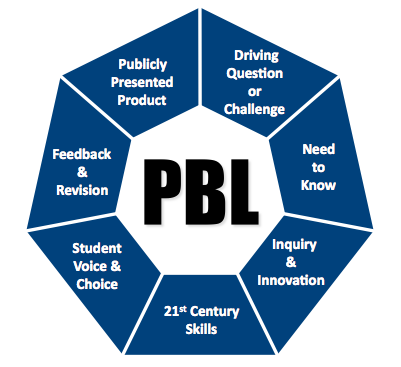
     What is Project-based Learning? 
    PBL is an approach to instruction that shifts from traditional teaching practices characterized by short, isolated, and teacher-centered lessons. Instead, it emphasizes learning that can be derived from long-term activities, which are interdisciplinary, student-centered, and integrated with real world issues and practices (Solomon, 2003; Staff, 2001; Willie, 2001). Many of the skills learned through PBL are those desired by today's employers, including the ability to work well with others and handle interpersonal conflicts, make thoughtful decisions, practice initiative, and solve complex problems (Kloppenborg & Baucus, 2004).
    Students are provided an interdisciplinary approach to learning and in the process made to develop several skills successively or at the same time as they work on a challenging project (Solomon, 2003). 3  
    1.  Definition from the Autodesk Foundation :

    We believe that PBL is at the heart of good instruction because it brings together intellectual inquiry, rigorous real-world standards, and student engagement in relevant and meaningful work. It is a comprehensive instructional model in which project work is central to student understanding of the essential concepts and principles of the disciplines. Well crafted projects:
    • Engage and build on student interests and passions
    • Provide a meaningful and authentic context for learning
    • Immerse students in complex, real-world problems/ investigations without a predetermined solution
    • Allow students to take the lead, making critical choices and decisions
    • connect students with community resources and experts
    • Require students to develop and demonstrate essential skills and knowledge
    • Draw on multiple disciplines to solve problems and deepen understanding
    • Build in opportunities for reflection and self-assessment
    • Result in useful products that demonstrate what students have learned
    • Culminate in exhibitions or presentations to an authentic audience


    2.  The Importance of Conceptual Model for PBL
    Those who advocate for PBL do not necessarily assert that it is exclusively the most effective educational approach there is but Staff (2001) observes that it is a way to make students engaged in school work, cut absenteeism, boost cooperative learning skills, and improve test scores. The students were able to develop self-motivation, initiative, and teamwork. In the study of Brunetti, Petrell, and Sawada (2003), higher achievement awareness was evident among students in universities instituting PBL compared to those heavily entrenched in the practice of traditional teaching. The ability to exhibit creativity and analytical skills in solving problems were displayed by the students. The research of Kloppenborg and Baucus (2004) reports on the learning outcomes of students as manifested in their successful experiences gained in planning, managing, and accomplishing projects. Successful experiences include the ability to resolve conflicts through creative problem-solving approaches and the accomplishment of a project that made them more aware of real life problems and issues. Learning then was fruitful for the students involved and not just mere assimilation of content-based knowledge.
    3.  Aim & Objectives of Project Work (PW)
    PW is an integrated learning experience that encourages students to break away from the compartmentalisation of the different disciplines. It aims to provide students with opportunities to explore the inter-relationships and inter-connectedness of subject-specific knowledge. The objectives of PW are to allow students to:
    §  Apply creative and critical thinking skills
    §  Improve communication skills (both oral and written)
    §  Foster collaborative learning skills
    §  Develop self-directed inquiry and life-long learning skills
    PW has been implemented in schools since 2000. At secondary level, it is recommended that PW be implemented at Primary 3, Primary 4 and/or Primary 5, and at Secondary 1, Secondary 2 and/or Secondary 3. By 2002, all primary and secondary schools are expected to implement PW at at least one level.
    At the pre-university level, PW is implemented at JC1 and CI2. JC1 and CI2 students in 2003 will sit for the PW national examination, and the result obtained will count towards entry into local universities from 2005 onwards.
    4.  Features of Project-Based Learning
    There are several features that facilitate use of project-based instruction within a classroom. It is important to provide students with a specific focus. What you expect of them from the project. It is important that the project has a real world connection. This can be achieved through making several connections to real life experiences.
    The project needs to allow students to not only make real life connections but also implement decision making skills, learning and applying new concepts and using their knowledge through a variety of education contexts.
    Working together with others. Collaborating with other students is a key element of Project based learning. As well as teachers and the broader community.
    Implementing research in a variety of environmental contexts is imperative through the application of several technologies including, computer programs, audio visual equipment and real life research to ensure that the full experience of the project is gained.

    Take a closer look at the wikipedia search result for Project-Based Learning here:  wikipedia

    5.  Roles

    PBL relies on learning groups. Student groups determine their projects, in so doing, they engage student voice by encouraging students to take full responsibility for their learning. This is what makes PBL constructivist. Students work together to accomplish specific goals.
    When students use technology as a tool to communicate with others, they take on an active role vs. a passive role of transmitting the information by a teacher, a book, or broadcast. The student is constantly making choices on how to obtain, display, or manipulate information. Technology makes it possible for students to think actively about the choices they make and execute. Every student has the opportunity to get involved either individually or as a group.
    Instructor role in Project Based Learning is that of a facilitator. They do not relinquish control of the classroom or student learning but rather develop an atmosphere of shared responsibility. The Instructor must structure the proposed question/issue so as to direct the student's learning toward content-based materials. The instructor must regulate student success with intermittent, transitional goals to ensure student projects remain focused and students have a deep understanding of the concepts being investigated. It is important for teachers not to provide the students any answers because it defeats the learning and investigating process. Once the project is finished, the instructor provides the students with feedback that will help them strengthen their skills for their next project
    Student role is to ask questions, build knowledge, and determine a real-world solution to the issue/question presented. Students must collaborate expanding their active listening skills and requiring them to engage in intelligent focused communication. Therefore, allowing them to think rationally on how to solve problems. PBL forces students to take ownership of their success.

    6.  Purpose

    Project-based learning (PBL):
    best defined as instruction relating questions and technology relative to the students' everyday lives to classroom projects. Students form their own investigation of their own group which allows students to develop valuable research skills. The students engage in design, problem solving, decision making, and investigative activities. It allows students to work in groups or by themselves and allows them to come up with ideas and realistic solutions or presentations. Students take a problem and apply it to a real life situation with these projects.
    Project-based Learning (PBL) provides complex tasks based on challenging questions or problems that involve the students' problem solving, decision making, investigative skills, and reflection that include teacher facilitation, but not direction. Project Based Learning is focused on questions that drive students to encounter the central concepts and principles of a subject hands-on.
    With Project-based learning students learn from these experiences and take them into account and apply them to their lives in the real world.

    7.  Structure

    Project-based learning(PBL): is an approach for classroom activity that emphasizes learning activities that are long-term, interdisciplinary and student-centered. This approach is generally less structured tha teacher-led classroom activities; in a project-based class, students often must organize their own work and manage their own time. Within the project based learning framework students collaborate, working together to make sense of what is going on. Project-based instruction differs from inquiry-based activity by its emphasis on collaborative learning. Additionally, project-based instruction differs from traditional inquiry by its emphasis on students' own artifact construction to represent what is being learned.

    8.  Elements

    The core idea of project-based learning is that real-world problems capture students' interest and provoke serious thinking as the students acquire and apply new knowledge in a problem-solving context. The teacher plays the role of facilitator, working with students to frame worthwhile questions, structuring meaningful tasks, coaching both knowledge development and social skills, and carefully assessing what students have learned from the experience. Advocates assert that project-based learning helps prepare students for the thinking and collaboration skills required in the workplace.

    9.  Teachers’ perception of autonomous learning:

    Prior to working on PBL, the two senior teacher researchers A & B, expressed doubt if students will opt to work on a project, which was not directly related to examinations and grades. “Our students in government colleges are comparatively slow, lazy, lack concentration to work and are not often ready to accept new ideas.” Researcher C opined that “there is always unlimited capacity in every learner to learn, only the learning environment is limited.” However, Researcher D gave a more positive response, saying “my learners are enthusiastic about learning English. I believe that if this enthusiasm is channeled and guided properly, they are surely capable of learning on their own.” Researcher A and E accepted that they had “never heard of the term ‘learner autonomy’ ” Also, the interviews brought out the fact that none of them had ever considered learner autonomy as a teaching strategy. This may suggest that teachers are unaware of this as a rich resource for effective learning.

      10.  Learners’ views:

    1.   Lack of time

     Although most of the learners enjoyed the PBL activity, but a few complained of lack of time. “ It gets stressful sometimes when we get many assignments of other subjects and we have to do this. One cannot give much time to this and enjoy it [E22]                                                                                                                                     

    2.   Group Dynamics

    An interesting fact that emerged in the general analysis the pre-PBL questionnaire was that the majority of learners who opted for working alone had secured high marks in public exams and perhaps did not feel the need for group/peer support.
    Another view is presented by a learner [E10] “I hope this research goes well. One thing: this programme has already proven to me: Its very difficult for girls to work together in a group especially if two of them want to be ‘the boss.’  This problem was also voiced in the group interview. One interviewee said ‘there should be rules of behaviour in projects like these.’  A revealing reflection is given by another learner [E29] of the same group.
    the planning of the newspaper, but the teacher’s coordination made it easy.

    3.   Teachers’ Role

    For learners, the teacher is still a very important figure in the PBL. “ At first I was quite confused about the planning of the newspaper, but the teacher’s coordination made it easier.”

    Text Widget

    Unordered List