The Difference Between The UK,
England, And Great Britain
The actual name of the sovereign state we are talking about is The United Kingdom of Great Britain and Northern Ireland
(UK). The United Kingdom is made up of the countries England, Scotland,
Wales, and Northern Ireland. The confusion of the terms seems to
revolve around the term “country” and the political powers that are
perceived based on that word. While the four countries that make up the
UK are considered separate in the minds of locals, and in certain
sporting events, their powers for local law and control are devolved
from the UK. Think of the 50 states of the United States, while each
state has their own set of laws, they all are still under the power of
the federal government. In the case of the UK, it is somewhat similar,
though certain responsibilities are also implied, like healthcare and
education, that are delegated to three of the four countries. The
responsibilities that are delegated differ from one country to the next.
England is the only country in which the UK does not devolve any powers
and instead it is legislated directly by the UK government. When it
comes to international politics, it is the sovereign nation of the UK
that is recognized and not any of the four constituent countries.
The term “Great Britain” refers to the land mass that comprises
England, Scotland, and Wales. Something that aids in the confusion as to
the difference between Great Britain and the UK is that the term is
sometimes internationally used as a synonym for the UK. For instance,
the UK’s Olympic team competes under the name “Great Britain” and the
ISO (International Organization for Standardization) gives the UK the
country codes of GB and GBR. This can be confusing given that the ISO
also codes England, Scotland, and Wales as subdivision countries of the
UK but Northern Ireland as a subdivision province. If you’re getting the
impression that Northern Ireland is the red-headed stepchild of the UK,
you may be right! (both figuratively and literally, if you believe the
current statistics for redheaded populations that is)
The confusion over the definition of these four countries, in
reference to the UK, is further muddied up in sporting competitions.
There are several international sporting events, like the commonwealth
games, and football competitions, in which each of the four has their
own team, and do not compete under a unified national team. When
competing under these conditions, their nations are referred to as “home
nations”. Because each team is from a specific home country, it can
lead some to think these countries have political autonomy as well.
Given the inebriated thought processes attained during the enjoyment of
these competitions, it’s not too hard to understand where this drunken
confusion comes from.
If you’re curious when these unions between the countries that
comprise the UK came about, it happened as follows: England and Wales
were joined in 1536. Scotland and England were joined together in 1707,
along with the previously joined Wales, to officially form the Kingdom
of Great Britain. Ireland decided to join up in 1801, at which point
the United Kingdom of Great Britain and Ireland was formed. In 1922,
however, many of the Southern counties of Ireland decided to remove
themselves from the union and the UK changed their name to the United
Kingdom of Great Britain and Northern Ireland.
So in summary:
- Great Britain = England, Scotland, and Wales
- UK = England, Scotland, Wales, and Northern Ireland (and the full name is the “United Kingdom of Great Britain and Northern Ireland”)
- England = Just the part of the island that is England
Bonus Facts:
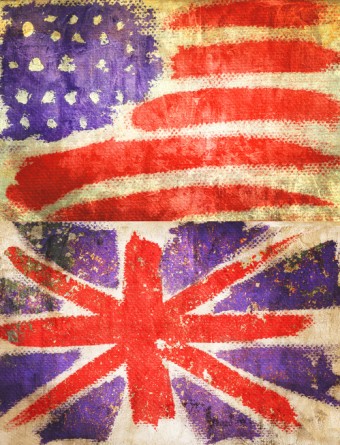
- The “Union Jack”, the flag of the UK was initially made by superimposing the Flag of England with the Flag of Scotland in 1606. When Ireland joined up in 1801, Saint Patrick’s Flag was added to the composition.
- The first peoples of the UK were the Picts who inhabited Briton around 10,000 BC. Two centuries later, they were driven north to Scotland by the Celts who promptly took over. The Romans then conquered in 45 AD and ruled for several more centuries. From around 600AD to around 900AD several peoples known as Angles, Saxons, and Jutes began to populate and govern the area. They became known as Anglo-Saxons. Then between 900 and 1400 came the conquering Vikings, then Danish, and finally the Normans. After that, in 1485 Henry Tudor claimed the English crown and the rest of British rule is an incestuous line of Kings and Queens of the monarchy leading to that handsome Prince William Mountbatten-Windsor and his lovely wife Kate!
- The United Kingdom ranks 28th on the Human Development Index. This index is a comparative statistic that measures a countries “human development” based on factors like life expectancy, literacy, education, and standards of living, like income potential. Unfortunately for those Northern Ireland folks, their neighbors to the south who left the UK without them, living in the Republic of Ireland, rank 7th.
- The top five countries on the Human Development Index are: 1- Norway 2- Australia 3- Netherlands 4- United States and 5- New Zealand. The bottom five countries for human development are: Chad, Mozambique, Burundi, Niger, and The Democratic Republic of Congo. So based on these statistics, you can assume you lost the ovarian lottery if you were born in Africa somewhere!
- The United Kingdom has 14 overseas territories and 3 crown dependencies that do not make up part of the UK itself. Crown dependencies differ from territories in that they are the possessions of “The Crown”, and as such, sovereignty over them lies with the Queen (or King, as the case may be). The executive responsibilities for them are carried out by Her/His Majesty’s Government. The 14 overseas territories are under the sovereignty of UK itself, and not solely the ruling monarch.
- As of July 9, 2011, there are 195 independent sovereign states in the world. This includes independent Taiwan. So if you’re Chinese, you might consider that there are only 194, but who’s counting anyway? The last country to gain recognition as an independent state was the Republic of South Sudan in July of 2011.
- The UK does not have a single judicial system; instead, it has three separate systems. These systems are Northern Ireland law, Scots law, and English law. As you might expect, English law governs Wales as well. There are a few instances where there are laws that have jurisdiction throughout all of the UK, immigration law being one; further, employment law is recognized in the three countries of Great Britain proper. The UK has four separate educational systems, and four separate healthcare systems as a result of both being devolved to each separate country.
- London is not only the capital of England, but is also the capital of the UK. The capital of Scotland is Edinburgh. The capital of Wales is Cardiff. Finally, the capital of Northern Ireland is Belfast.
- The national anthem of the UK is “God Save the Queen”, though the lyrics are changed to “God Save the King” when the ruling monarch is a man. One can only imagine the confusion and tumult at sporting events directly after the death of the ruling monarch where the gender of the heir is different than that of their predecessor and some people have heard of the death and others haven’t.